Web of Deceit
Amber Editor Janine Hospes reflects on Amie Dicke's work.
How and when it started exactly, I don’t remember. Sometimes you hear these stories in which she, meticulously, with an eye for detail and feeling for drama, refers to the first moment at which she knew that they were meant for each other (‘do you remember, on the stairs in front of the library, you were wearing your old Levi’s and looked me in the eye making me drop The Great Gatsby’); he nods compassionately; memory is fallible. Like I said, I can’t remember the exact details of the start of our romance. It has been a while. Was the sun shining? Was it raining? I don’t remember and it doesn’t matter. It wasn’t about the way you looked at me nor how you smiled at me. All of a sudden it was there, that feeling, I, understanding precisely what you meant. You don’t know it (yet), but maybe that’s what makes this love so beautiful: the longing for the unattainable. But because I no longer want to keep my fascination for the work of Amie Dicke silent and want to share it with everyone, below is my ode to her.

‘All the world's a stage, And all the men and women merely players; They have their exits and their entrances; And one man in his time plays many parts’
Shakespeare brought one of his many memorable characters to the stage to touch upon something vital: the world is a stage and in the course of our lives we all play different parts until the moment the curtain drops. False appearances is one of the recurring themes in his plays; nothing is what it seems.
In our world false appearances play a leading role as well. With clothing and make-up we can mask and disguise a lot, like Hamlet expresses when he flies at his beloved Ophelia: ‘I have heard of your paintings too well enough. God has given you one face and you make yourselves another’.
According to artist Amie Dicke, who questions the female image (as portrayed in magazines) in her own unique way, we need that outer layer of appearances to protect ourselves: ‘Many cultures use masks in rituals or in daily life, but we have them as well. Everything is packaged, masked. If you put on tights you apply a layer, you do that to cover something and to keep from baring all. It makes you feel protected. When you apply foundation to your face you do the same. We need it, that layer, that forgery.’
An interesting observation that makes us think about the way we present ourselves to the outside world. Yet, you could also consider clothes and make-up as tools to express our inner self, our personality. However, the photos that are served up in fashion magazines and which we usually swallow without questioning are often so unreal in their glossy perfection that we could never live up to this ideal. What’s more, everything that deviates from this norm is considered to be ugly.
Amie Dicke questions the manner in which women are portrayed in the media, by applying different techniques (she cuts, sands, burns, hammers nails through faces and bodies, saturates photos in wine or wax or covers them with foundation) she adds or removes something and thus reveals the layers and facets that make us who we are but that are often hidden behind different masks. Identity never is conclusive, fixed or well-defined.

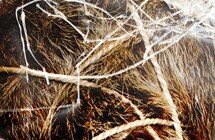
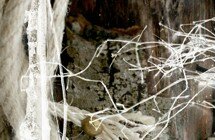
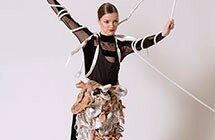
In her works Red-Hot (2004) and Kelly (2002) Amie has cut away parts of the faces and bodies of photo models. What is left is a disillusion. The images evoke longing and the accompanying loneliness, visualised by black, sticky threads that reminds us of a web. Stripped from their humanity, the women have become somewhat animalistic and seem caught in seduction or deception. On the one hand they are victims of the ideal of beauty that has been forced upon them, on the other hand they lure the viewer into their web of deceit. This way Amie Dicke shows us, quite strikingly, that nothing is conclusive; you can be a victim and perpetrator at the same time: ‘I victimised models and in doing so I could express my feeling of emptiness, my loneliness and my desire. But the figures also became offenders.’
This also plays a role when we look at fashion photos. We are both spectator and participant: even when we do nothing at all and put up with everything, we take part in the process and keep the deception alive. Despite the fact that we are well aware that the photos in fashion magazines have been manipulated, these images influence the way we see ourselves.
The thing that makes Dicke’s work fascinating is the fact that she shows us the many layers hidden behind the layer of varnish, by manipulating this superficial top layer in different ways. These layers do not only concern humans, but everything that surrounds us. Amie Dicke’s work makes us wonder: what is hidden beneath the surface? What is identity? Do make-up and clothing function as a protective layer and cover or can you use them to show who you are? Questions that cannot be answered straight away. What is clear though: by not just accepting everything that is served up to us without thinking, we can make sure we don’t get tangled up in the web of temptation.

Amber Editor Janine Hospes graduated from Radboud University Nijmegen with a thesis on the representation of women in nineteenth and twentieth century British novels.